Have you ever searched for something on Google and wondered why one website appears first while another is buried on page five?
The answer is usually SEO.
If you're new to websites, blogging, or online business, SEO might sound like a technical term reserved for marketers and developers. In reality, it's much simpler than it seems.
Think of SEO like opening a new restaurant.
You could have the best food in town, but if nobody knows your restaurant exists, customers won't come. SEO is what helps people discover your website when they search online.
In this guide, you'll learn:
What SEO is
How Google finds websites
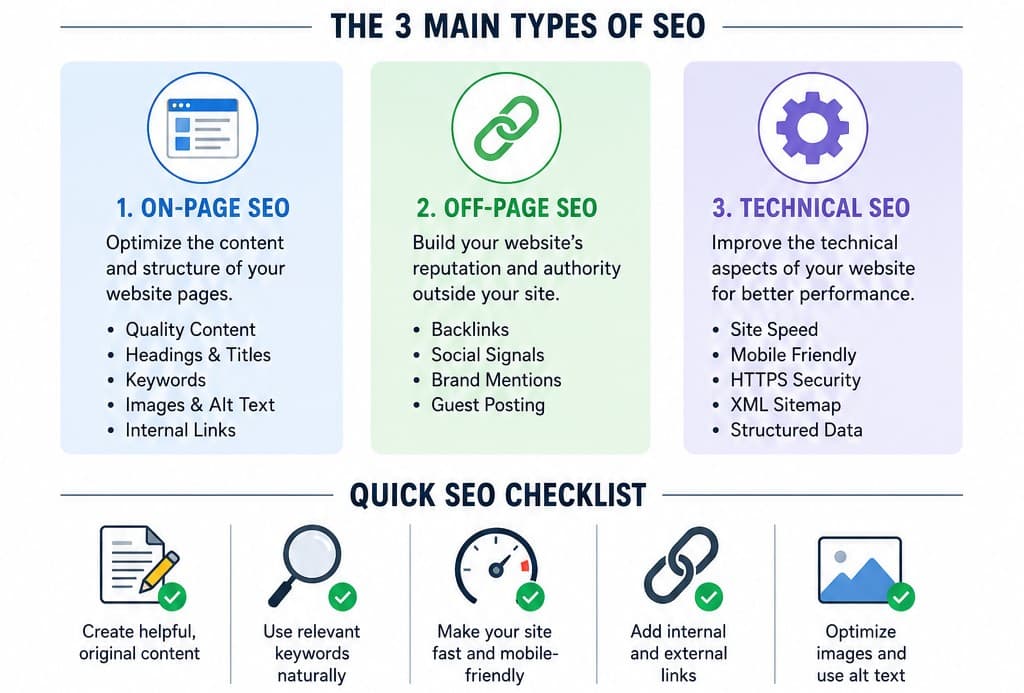
The three types of SEO
Real-life examples
Common beginner mistakes
Tips you can start using today
Let's begin.
What is SEO?
SEO stands for Search Engine Optimization.
It is the process of improving your website so search engines like Google can understand it better and show it to people searching for related topics.
Simply put:
SEO helps connect people who are searching with websites that have the answers.
Imagine you own a pet store.
Someone searches:
"Best food for Labrador puppies."
If your website has a detailed article answering that question, Google may recommend your page.
The better your content and website are, the higher your chances of appearing near the top of the search results.
Why is SEO Important?
Imagine building a beautiful house in the middle of a forest with no roads leading to it.
Even though the house is amazing, nobody will ever find it.
A website without SEO is similar.
SEO helps build the roads that guide visitors to your website.
Benefits include:
More visitors without paying for ads
Increased trust and credibility
Better user experience
More leads and sales
Long-term growth
Unlike paid advertising, good SEO can continue bringing visitors for months or even years after your content is published.
How Does Google Work?
Google doesn't magically know every website.
Instead, it follows three important steps.
Step 1: Crawling
Google sends automated programs called crawlers (also known as spiders or bots) across the internet.
Their job is to discover new pages.
Imagine a librarian walking through every bookstore looking for new books.
That's exactly what Google's crawlers do.
Step 2: Indexing
After Google discovers a page, it reads the content and stores it in a massive database called an index.
Think of it like adding a book to a library catalog.
If your page isn't indexed, it won't appear in search results.
Step 3: Ranking
When someone searches for something, Google compares millions of pages in its index.
It tries to answer one question:
"Which page will help this person the most?"
Google considers hundreds of ranking factors, including:
Content quality
Relevance
Website speed
Mobile friendliness
Backlinks
User experience
Website security
The pages that provide the best overall experience usually rank the highest.
The Three Types of SEO
Many beginners think SEO is just writing articles.
In reality, SEO has three major parts that work together.
1. On-Page SEO
On-page SEO refers to everything you do on your own website to improve its rankings.
This is the part you have the most control over.
What Does On-Page SEO Include?
High-quality content
Keywords
Page titles
Meta descriptions
Headings
Internal links
Images
Alt text
URL structure
Example
Suppose you own a gardening blog.
Instead of writing a title like:
Plants
A better SEO title would be:
10 Easy Indoor Plants That Anyone Can Grow
Which title tells Google exactly what the page is about?
The second one.
Example of Good Keyword Usage
Bad:
Cheap laptops. Cheap laptops are the best cheap laptops because cheap laptops save money.
Good:
Looking for an affordable laptop? Here are the best budget laptops for students, professionals, and everyday users.
Notice how the second paragraph sounds natural.
That's exactly what Google prefers.
Organize Your Content
Imagine reading a book with no chapters.
Confusing, right?
The same applies to websites.
Use headings like:
Introduction
Benefits
Step-by-Step Guide
Frequently Asked Questions
Headings make content easier for both readers and search engines.
Optimize Images
Instead of naming an image:
IMG_43882.jpgUse:
fresh-organic-apples.webpAlso add descriptive alt text.
Good:
Basket filled with fresh organic apples.
Bad:
Image1
2. Off-Page SEO
Off-page SEO refers to activities outside your website that improve its reputation.
The biggest factor here is backlinks.
What Are Backlinks?
A backlink is when another website links to yours.
Imagine you're looking for a plumber.
One friend recommends someone.
You might trust them.
Now imagine ten experienced plumbers recommend the same person.
Your confidence grows.
Google works similarly.
The more trusted websites that link to yours, the more trustworthy your site appears.
Example
Suppose you publish an excellent article about photography.
A popular photography website links to your article because it's helpful.
Google sees that link as a vote of confidence.
Not all votes are equal, though.
A link from a respected website carries much more weight than dozens of links from low-quality websites.
Other Off-Page SEO Factors
Brand mentions
Social media sharing
Guest blogging
Online reviews
Local citations
While social media shares aren't direct ranking factors, they can increase visibility and attract backlinks naturally.
3. Technical SEO
Technical SEO focuses on how well your website works behind the scenes.
Even amazing content can struggle if your website is difficult for search engines to access.
Website Speed
Imagine clicking a website that takes 15 seconds to load.
Most people leave before it finishes.
Fast websites create happier visitors.
Ways to improve speed:
Compress images
Remove unnecessary scripts
Use browser caching
Use a Content Delivery Network (CDN)
Mobile Friendliness
Today, most Google searches happen on smartphones.
Your website should:
Fit every screen size
Have readable text
Load quickly
Use buttons that are easy to tap
Responsive design is essential.
HTTPS Security
Notice the padlock icon beside many website addresses?
That's HTTPS.
Secure websites protect user data and are generally preferred over unsecured HTTP sites.
XML Sitemap
A sitemap is like giving Google a map of your website.
Instead of making Google search every corner, you provide a list of all important pages.
This helps search engines discover new content faster.
Clean URLs
Bad:
example.com/page?id=8392&cat=2Good:
example.com/seo-guideSimple URLs are easier for users to remember and help search engines understand the topic.
How the Three Types Work Together
Imagine building a successful restaurant.
Great food represents On-Page SEO.
Positive reviews and recommendations represent Off-Page SEO.
Clean tables, fast service, and easy parking represent Technical SEO.
If one part is missing, customers may not return.
The same applies to websites.
Good SEO requires all three.
Common SEO Mistakes Beginners Make
Many people unknowingly hurt their rankings.
Here are some common mistakes:
Keyword Stuffing
Using the same keyword repeatedly makes content difficult to read.
Write naturally.
Publishing Thin Content
A 200-word article rarely answers complex questions.
Aim to provide complete, useful information.
Ignoring Mobile Users
Always check how your website looks on a phone.
Slow Website
Large images and unnecessary plugins can significantly slow down your website.
Copying Content
Google prefers original content.
Copying articles from other websites can damage your rankings.
Forgetting Internal Links
Link related articles together.
This helps visitors discover more content and helps search engines understand your site structure.
Simple SEO Checklist Before Publishing
Before clicking "Publish," ask yourself:
Does the title clearly explain the topic?
Does the article answer the reader's question?
Have I used headings?
Are my images optimized?
Is the page mobile-friendly?
Does the website load quickly?
Have I linked to related articles?
Is the content original?
Would I genuinely recommend this page to someone else?
If the answer is yes, you're heading in the right direction.
Is SEO a One-Time Task?
No.
SEO is an ongoing process.
Search engines constantly update their algorithms, competitors publish new content, and user behavior changes over time.
Successful websites regularly:
Update old articles
Improve page speed
Add new content
Fix broken links
Monitor performance
Earn new backlinks
Think of SEO like maintaining a garden. You can't plant seeds once and expect flowers forever. Regular care keeps everything healthy and growing.
Final Thoughts
SEO isn't about tricking Google—it's about creating the best possible experience for your visitors.
When you publish helpful content, organize it well, build trust through quality backlinks, and ensure your website is fast and easy to use, you're following the core principles of SEO.
Remember the three pillars:
On-Page SEO helps Google understand your content.
Off-Page SEO builds your website's authority and trust.
Technical SEO ensures your website performs well for both users and search engines.
You don't need to master everything overnight. Start with the basics, improve consistently, and focus on helping your audience. Over time, those small improvements can lead to higher rankings, more traffic, and lasting success.
SEO is a marathon, not a sprint—but every well-optimized page brings you one step closer to the finish line.