
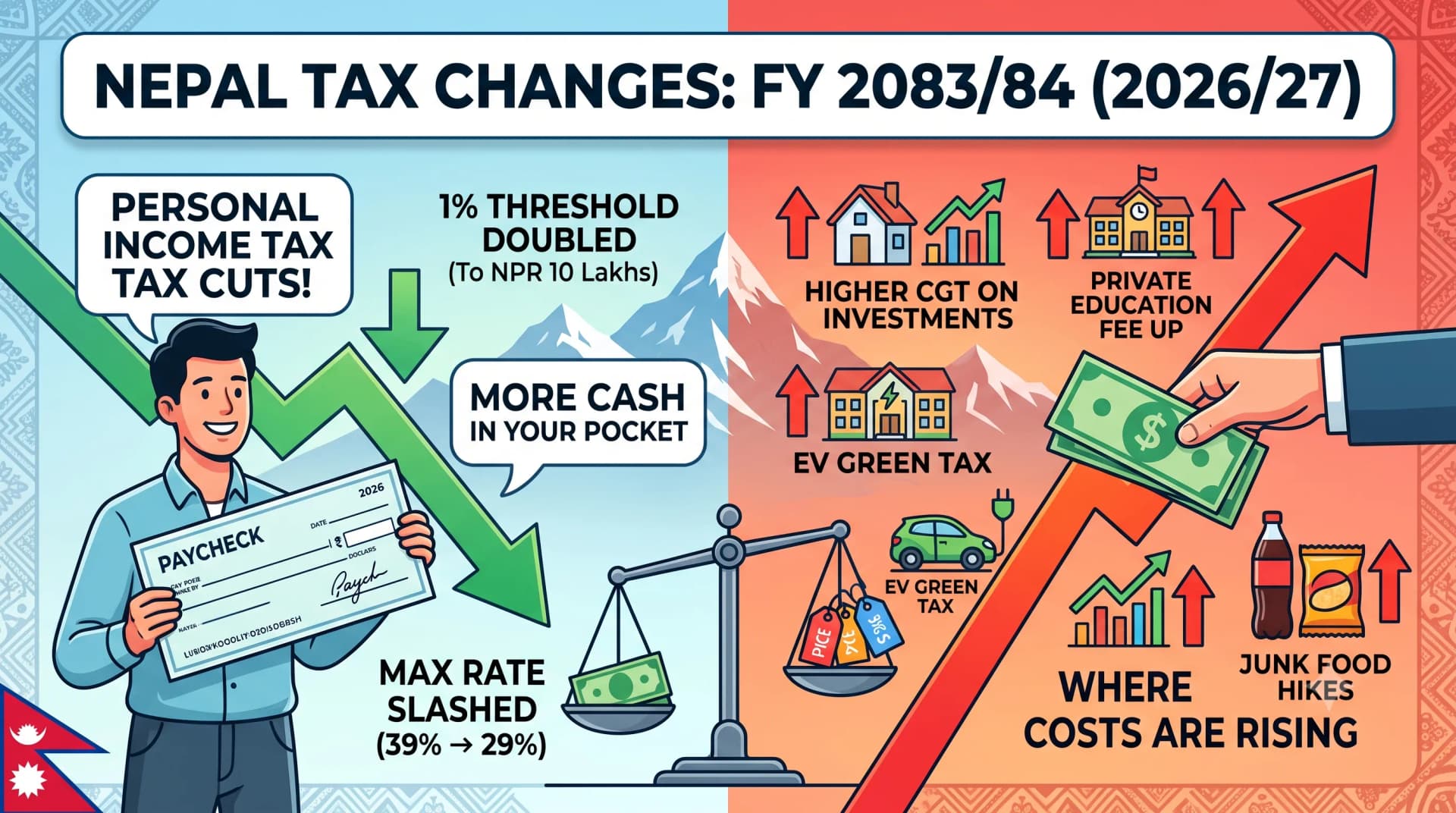
With the arrival of the new fiscal year 2083/84 (2026/27), Nepal has rolled out a sweeping set of changes to its tax structure. For everyday earners, investors, and consumers, the new budget is a mixed bag: significant relief on your monthly paycheck, but new costs sprinkled across daily life and investments.
If you are wondering exactly how these new policies will affect you, here is a straightforward, jargon-free guide to the most important tax changes of the year.
1. Massive Relief for Salaried Employees
For the first time in years, the government has given a major tax break to the middle class by restructuring personal income tax slabs.
The 1% Threshold Doubled: The lowest 1% tax bracket (the Social Security Tax) has been doubled from NPR 5 Lakhs to NPR 10 Lakhs (1 million rupees). This means progressive taxes (10% and above) do not kick in until your annual taxable income crosses the 1 million mark.
A Unified Schedule: In the past, singles and married couples had different tax brackets. That split is now gone—the NPR 10 Lakh first bracket applies universally to everyone.
Cheaper Top Brackets: The maximum personal income tax rate has been slashed by a full 10 percentage points—dropping from a hefty 39% down to 29% for high earners.
Here are the new personal income tax slabs:
Up to NPR 1,000,000: 1%
NPR 1,000,001 to 1,500,000: 10%
NPR 1,500,001 to 2,500,000: 20%
NPR 2,500,001 to 4,000,000: 27%
Above NPR 4,000,000: 29%
2. Higher Capital Gains Taxes for Investors
While your salary is safer, your investments will be taxed more heavily. To make up for the income tax cuts, the government has bumped up the Capital Gains Tax (CGT) on real estate and the stock market.
Stock Market Traders:
If you hold shares for more than a year, your CGT has increased from 5% to 7.5%.
If you sell within a year, the short-term CGT jumps from 7.5% to 10%.
Real Estate Transactions:
For property held for more than 5 years, the CGT is up from 5% to 7.5%.
For property sold within 5 years, it has doubled from 5% to 10%.
3. New Fees on Healthcare, Education, and Ride-Sharing
Be prepared to pay slightly more for private services and everyday conveniences.
The 3% "Equity Fee": A new 3% fee has been imposed on services provided by private educational institutions and private hospitals. The government plans to use these funds to develop public academic and healthcare infrastructure, but it means higher tuition and medical bills for consumers. (As of July 21, 2026, government has decided to halt this Equity tax)
Ride-Sharing Gets Taxed: Popular ride-hailing apps (like Pathao or InDrive) will now be subject to a 5% Value Added Tax (VAT).
Electricity VAT: Households that consume more than 50 units of electricity will now see a 5% VAT applied to their bills.
4. Green Taxes and "Sin Taxes"
The budget places a heavy emphasis on environmental sustainability, alongside a crackdown on unhealthy consumer goods.
Electric Vehicles (EVs): A unified "Green Tax" heavily impacts EVs. The effective tax/customs duty scales drastically with the vehicle's price—ranging from a modest 2.5% on EVs valued up to NPR 20 Lakhs, to a massive 112.5% additional levy on luxury EVs over NPR 50 Lakhs.
Junk Food and Drinks: Excise duties have surged on unhealthy treats. Taxes on potato chips, cheese balls, and similar snacks have seen steep hikes (chips went from NPR 18/kg to NPR 30/kg, for example). Energy drinks, soft drinks, and even non-alcoholic beers will also see massive excise duty jumps.
Gold and Jewelry: The 2% luxury tax on gold has been scrapped. However, a new 0.5% "skill promotion fee" is now applied when purchasing gold and silver jewelry.
The Bottom Line
The FY 2083/84 budget represents a significant pivot. The government is directly easing the cost of living for the salaried middle class by keeping more cash in their pockets every month. However, it is balancing the books by targeting higher-yield investments (stocks and real estate), luxury goods, private institutional services, and consumer habits.
Here are some of the best salary tax calculators:
SalaryTaxNepal (Most popular salary tax calculator of Nepal, currently updated with new UI),
SajiloCalculator (Underated, can calculate tax with increment in a year, includes ETDS calculator as well)
Disclaimer: Tax laws can be complex and situational. It is always recommended to consult with a certified tax professional or auditor in Nepal regarding your personal filing requirements.